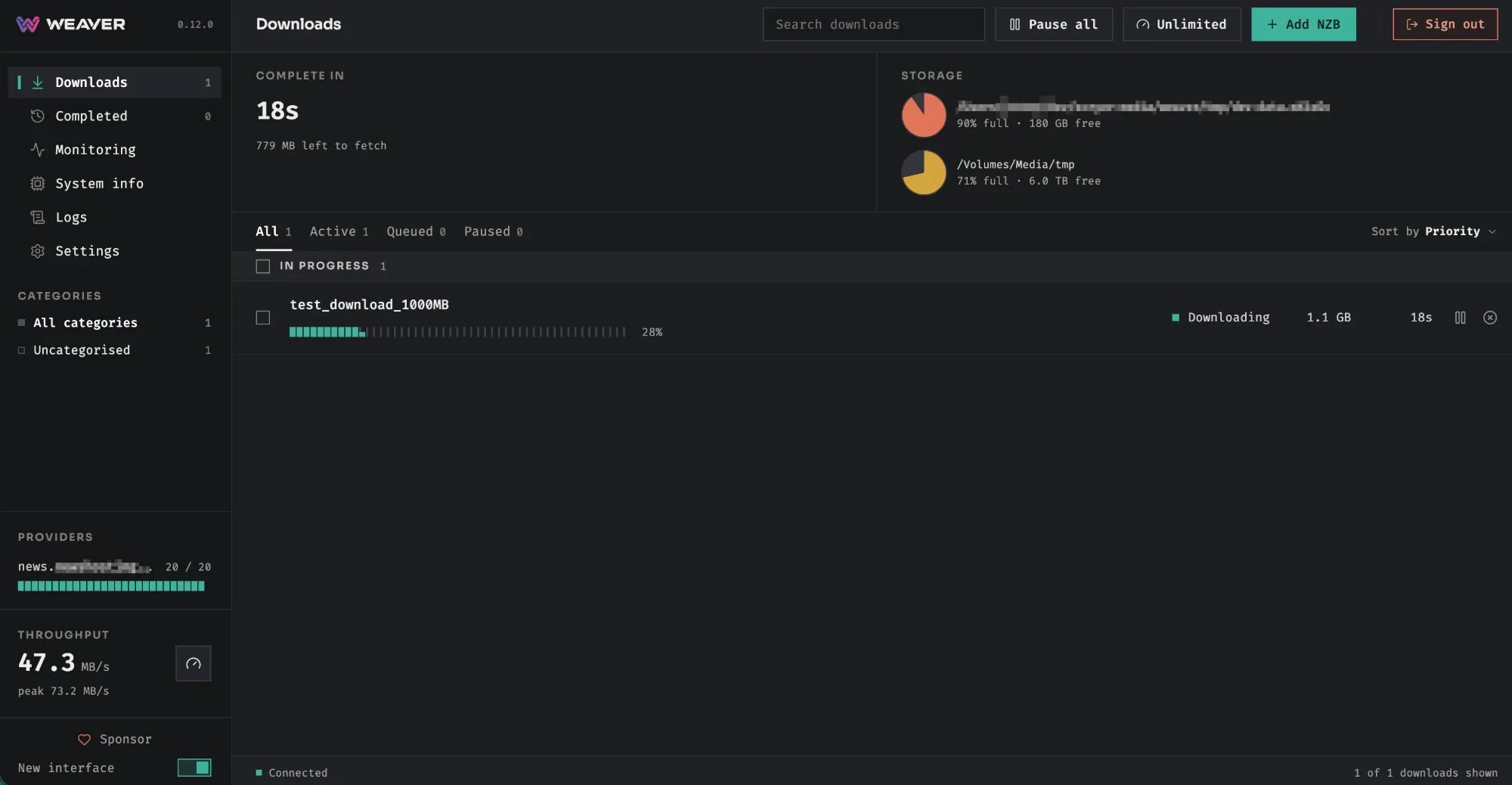
Self-hosted Usenet downloading with repair and extraction.
Weaver coordinates downloading, verification, repair, and extraction as one pipeline. It
prioritizes whatever gets your finished file to disk next, with no external unpackers or repair tools.
single binary · repairs while downloading · Docker · Linux · macOS · Windows
ONE COORDINATED PIPELINE
Every stage works toward a finished file
Keeps extraction moving
Along with prioritizing recovery blocks, Weaver pulls forward the archive pieces that unblock identification and extraction, keeping the whole job advancing.
Smarter server use
Balances latency and load, backs off when a provider hits capacity, and saves backup servers until your primaries are truly exhausted.
Verify as bytes arrive
Like other downloaders, Weaver verifies clean files as data arrives. It also records repair-block checksums, so damaged files reach repair with the bad blocks already identified.
Repair without leaving Weaver
PAR2 verification and repair run in process, tuned for modern CPUs and accelerated by the GPU on supported Macs.
Streaming extraction
For common RAR posts, Weaver writes the finished file as data arrives instead of writing and rereading the archive. Repair still works, and 7z extraction resumes instead of restarting.
More formats, nothing extra
RAR, 7z, ZIP, tar, gzip, bzip2, xz, zstd, and brotli are handled in process, with no external unpackers or repair tools to maintain.
STREAMING EXTRACTION
The finished file lands with the download
A conventional RAR pipeline writes the archive, reads it back, then writes the
extracted file. That is three trips across storage, and on a NAS every trip runs at
network speed with two of them starting only after the download ends. Weaver removes
the archive round trip for the store-method RARs commonly used for video.
CONVENTIONAL DIRECT UNPACK
Three storage passes
WRITE ARCHIVEREAD ARCHIVEWRITE FILE
VS.
WEAVER RAR
One storage pass
DECODE AS DATA ARRIVESWRITE FINAL FILE
RAR goes straight to its destination
Decoded bytes are written at their final file offsets as articles arrive, so the
archive volumes never need to land on disk. Encrypted archives and PAR2 repair still
work. If streaming cannot finish, Weaver reconstructs the archive from bytes it already
has and falls back without starting the download over.
7z starts early and resumes
Compressed 7z data must still be stored, but Weaver decodes it while the split archive
arrives and writes output concurrently. When damage interrupts extraction, it keeps the
verified prefix, waits for repair, and resumes instead of throwing away completed work.
CHECKED TWO WAYS, READ ONCE
Every byte is verified twice before it is even finished downloading
Two different people vouch for a Usenet post. The poster stamps a checksum on every
article. The PAR2 set stamps a checksum on every repair block. The two grids are cut at
unrelated places, so a stretch of data that satisfies both was seen intact by both.
Weaver computes both grids from the single checksum pass it already runs while decoding.
ONE STREAM OF DECODED BYTES
ARTICLE GRID
Cut where the poster split the file into articles. Catches damage in transit and
tells Weaver which article to fetch again, from a different server, right away.
REPAIR GRID
Cut where the PAR2 set defines its repair blocks, which almost never line up with
articles. This is the evidence repair actually needs, and Weaver has it before the
file is closed.
Clean files finish instantly
When the last article lands and both grids agree, the file is done. There is no
verification pass afterwards and nothing is read back from disk.
Damaged files skip the search
Other downloaders know a file is bad and hand it to PAR2 to find out where. Weaver
hands PAR2 the list of bad blocks, so repair starts with the answer instead of the
question.
Several PAR2 sets, no confusion
A post can carry more than one recovery set, each with its own block size. Weaver
tracks every grid in the same pass, so each set gets its own verdict. One clean set
never signs off on another, and one damaged set never drags a clean one into repair.
Checksums detect corruption, not forgery. Anything the grids cannot vouch for is verified the conventional way at completion.
END-TO-END BENCHMARKS
Your queue drains sooner
From the moment an NZB is submitted to a finished file. Same fixtures, same shaped link, same transport, every client paired in the same measurement block.
B3-bluray-rtt100 · Submission to terminal state and verified output; median over paired blocks.
Animations compress each race to 13 seconds. CPU traces illustrate measured averages, not sampled activity; 100% equals one CPU core. “Faster” is (baseline time ÷ Weaver time − 1) × 100; CPU savings compare total CPU seconds.
Weaver handles extraction and repair inside the application, including archive and
compression formats that other Usenet downloaders do not route automatically.
FORMAT
WEAVER
NZBGET
SABNZBD
RAR (all formats)
Native + streaming
External UnRAR
External UnRAR
7z
Native + streaming
External 7-Zip
External 7zz
ZIP
Native
External 7zz
TAR
Native
Native - limited formats
xz, zstd, brotli, bzip2 & gzip
Native
PAR2
Native
Native
External process
Native means no separate unpacker or repair executable is required.
HOW IT COMPARES
One Weaver vs. the usual downloaders
SABnzbd and NZBGet already handle the fundamentals well: all three prioritize needed repair data and retry bad articles across servers. Weaver goes further by sharing progress across the entire pipeline.
WEAVER
NZBGET
SABNZBD
Beyond repair
Prioritizes identification and extraction blockers
Priority, then file order
Priority, then file order
Server handling
Latency/load routing plus adaptive capacity
Penalty windows plus fixed limits
Penalty windows plus 502 thread reduction
Damaged-file evidence
Repair-block evidence captured in flight
File-level plus partial block checks
File-level evidence
Article decoding
Hardware-accelerated yEnc and uuencode
Hardware-accelerated yEnc; standard uuencode
Hardware-accelerated yEnc; standard uuencode
Runtime
Native Rust; every stage runs in parallel
Native C++; thread per connection
Python with native decoding, TLS, and disk I/O; core coordination remains GIL-bound
Existing integrations
NZBGet API plus both script formats
NZBGet native
SABnzbd native
Architectural comparison. Exact performance varies with hardware, providers, and archive shape.