Context-Free Vs Context-Aware Release Parsing
Release parsing is the step that turns a messy release name into structured data the rest of the system can trust.
That one step affects much more than the parse itself:
- Title matching
- Episode identity
- Release-group handling
- Quality and source detection
- Language and subtitle hints
- Downstream release scoring and rules
Scryer and Sonarr both parse release names seriously, but they do it in different ways.
What “Context-Free” Means Here
Section titled “What “Context-Free” Means Here”For Sonarr, context-free means the parser works primarily from the release string itself — it normalizes the name, matches identity patterns like season and episode numbers, then runs dedicated extractors for quality, release group, and language. That works well when naming is regular, but ambiguous names can force a best-effort read when the same token could mean different things depending on the title:
- Is a number an episode number or part of an episode title?
- Is a bracketed prefix a release group or part of the title?
- Is a trailing phrase a release label, a subtitle hint, or just noise?
What “Context-Aware” Means In Scryer
Section titled “What “Context-Aware” Means In Scryer”Scryer can parse with a real target context — canonical title, aliases, facet, known years, external IDs, and episode numbering — and keeps several candidate interpretations alive at once rather than committing immediately to one reading. It scores and prunes those candidates, then picks the strongest result for that specific title. A separate metadata enrichment pass runs after to normalize and fill in additional detail.
Diagram
Section titled “Diagram”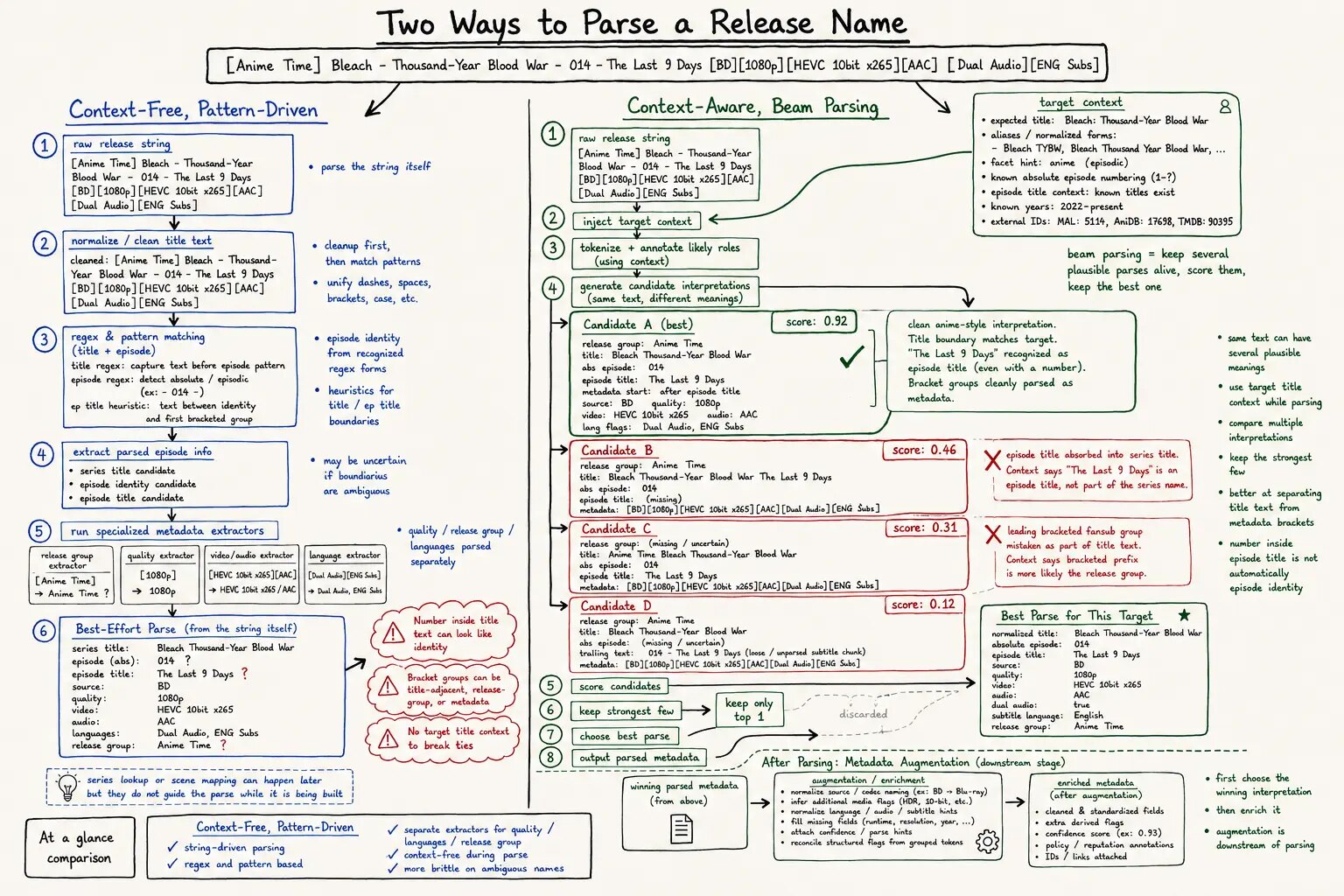
Last Benchmark Run
Section titled “Last Benchmark Run”The table below reflects the most recent parser comparison corpus: 1000 release names spread equally across movies, anime, and series. For series and anime, the baseline parser is Sonarr. For movies, the baseline is Radarr.
| Scope | Metric | Baseline | Scryer | Delta |
|---|---|---|---|---|
| Series | Title | 81.27% | 100.00% | +18.73 |
| Series | Kind | 96.07% | 100.00% | +3.93 |
| Series | Episode | 94.56% | 99.70% | +5.14 |
| Series | Quality | 93.96% | 100.00% | +6.04 |
| Series | Source | 74.62% | 100.00% | +25.38 |
| Series | Release Group | 96.98% | 99.09% | +2.11 |
| Series | Full overlap match | 54.68% | 98.79% | +44.11 |
| Anime | Title | 74.70% | 98.80% | +24.10 |
| Anime | Kind | 90.66% | 98.49% | +7.83 |
| Anime | Episode | 89.46% | 98.19% | +8.73 |
| Anime | Quality | 93.07% | 99.70% | +6.63 |
| Anime | Source | 79.22% | 99.40% | +20.18 |
| Anime | Release Group | 95.18% | 96.69% | +1.51 |
| Anime | Full overlap match | 58.13% | 93.98% | +35.85 |
| Movies | Parse rate | 99.70% | 100.00% | +0.30 |
| Movies | Title | 98.50% | 99.40% | +0.90 |
| Movies | Kind | 99.10% | 99.40% | +0.30 |
| Movies | Year | 99.70% | 100.00% | +0.30 |
| Movies | Quality | 84.38% | 98.80% | +14.42 |
| Movies | Source | 95.80% | 99.40% | +3.60 |
| Movies | Release Group | 88.59% | 99.40% | +10.81 |
| Movies | Edition | 96.70% | 100.00% | +3.30 |
| Movies | Full overlap match | 68.47% | 98.20% | +29.73 |
| TOTALS | Average across all rows | 87.62% | 99.03% | +11.41 |
The biggest gains show up in title resolution, source detection, and full-structure overlap — particularly on anime. The “full overlap match” row is the most useful summary: it measures how often the parser got the entire release interpretation right at once, not just isolated fields.
Why This Difference Matters
Section titled “Why This Difference Matters”Parsing isn’t just cosmetic.
If the parser is uncertain about title boundaries, source, release group, or episode identity, everything downstream gets noisier:
- Release filtering
- Quality policy evaluation
- Upgrade logic
- Anime-specific routing
- Search result ranking
Better structured parsing reduces silent misreads and makes later decisions less brittle.
Related Concepts
Section titled “Related Concepts”- Domain Event Architecture — technical overview of Scryer’s backend design and the systems that depend on accurate parsing
- Domain Event Architecture — explains how parsed release data flows through Scryer’s event-driven backend
- Scryer Vs Sonarr And Radarr — comparison where parsing accuracy is one of the key differentiators discussed
- Concepts — definitions for all logical constructs, including releases and quality profiles that depend on parser output
- Anime — the facet where anime-specific parsing details like episode numbering and naming conventions matter most
- Series — the facet where multi-episode and season-structured parsing accuracy has the most operational impact
- Rules — conditions evaluated against parsed release data; better parsing means more reliable rule evaluation